Final Fantasy VII Remake surprised me back in 2020. It was more than a facelift. The combat and story structure were reworked in ways that felt fresh while still respecting what I loved about the original.
Its ATB-based action combat brought real strategy, and the expanded storytelling pulled in threads from spin-offs to make Midgar feel both familiar and newly alive. At the time, I summed it up as “bigger and bolder than expected.”
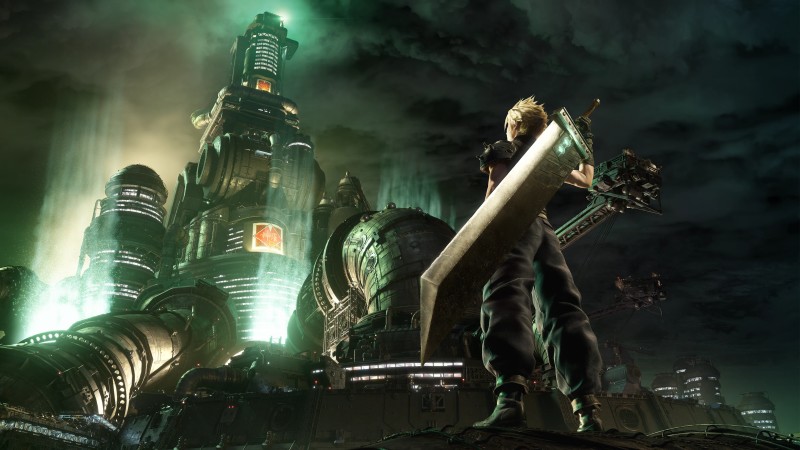
Producer Yoshinori Kitase has been clear that Remake is only the first part of a trilogy. That first game stopped around the halfway mark of Disc 1, right as the world opens up. The real chase for Sephiroth, the true spine of Final Fantasy VII, starts after that. That is where Rebirth begins.
Between the two sits the Intergrade Yuffie episode. Yuffie was adorable and the mini-games were fun, but it was a small side story with limited new mechanics beyond synergy. That set my expectations for Rebirth: more cutscenes, a handful of new ideas, and a world map.
Then I actually played it. The scope blew past my expectations. Rebirth does not just build on Remake. It jumps beyond it.
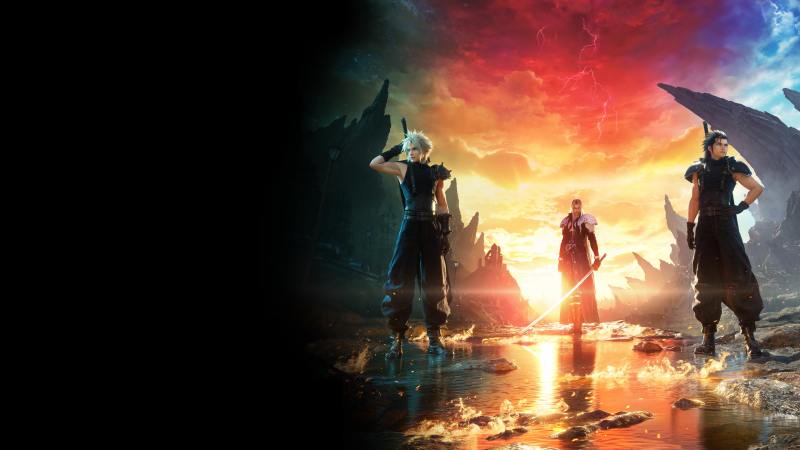
Visuals and Presentation Maxed Out
The story continues in Remake’s style, with some scenes reordered. Wutai is not part of this entry, but a big moment from Disc 2 has been pulled forward. Kitase said the overall direction would stay true to the original, and that is accurate, though there are still surprises.
I will avoid spoilers here. The main story is about the same length as Remake, around 40 hours, covering roughly half a disc of the original game’s material.
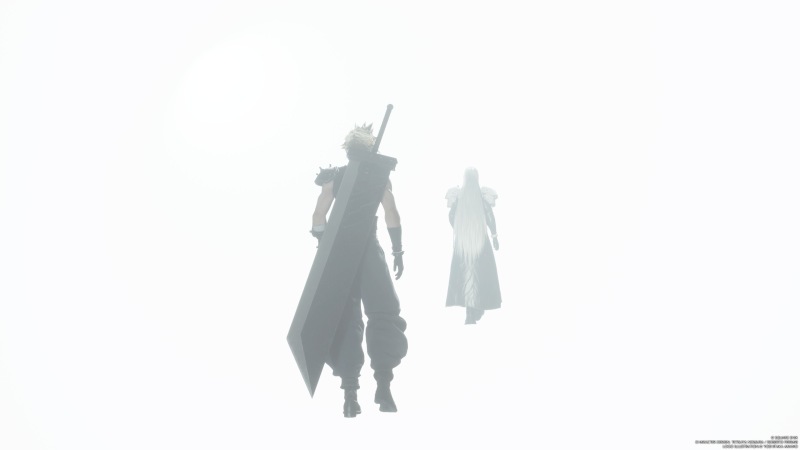
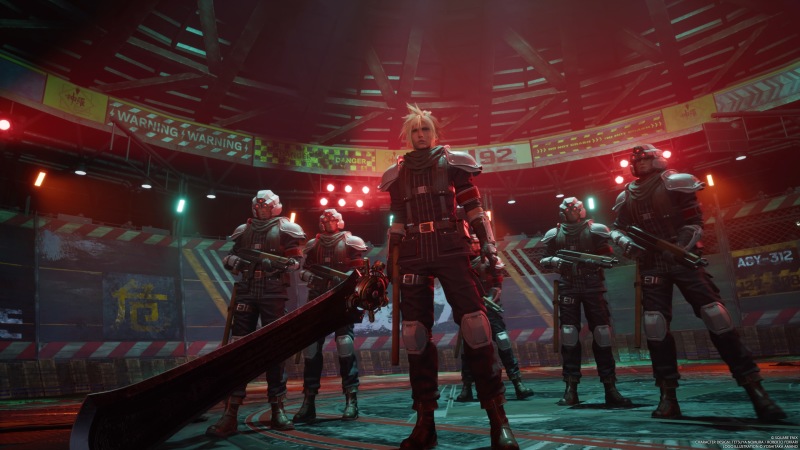
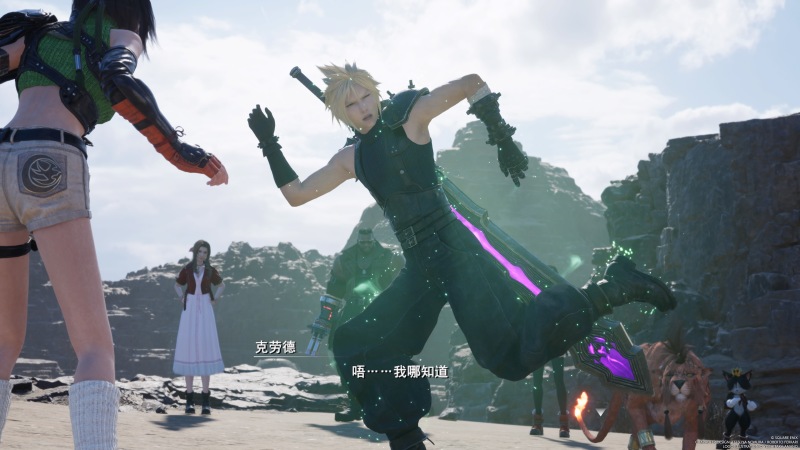
The biggest leap is in presentation. Since this is PS5-only, textures, models, and lighting take a real step up. Facial animation is especially strong. The eyes, the mouth, small movements in the cheeks, all of it sells emotion. At times you can read the scene without a single line of dialogue.
That said, performance mode can look a little soft, likely because the world is much bigger. Until Square Enix improves it, I recommend quality mode. It is 30 fps, but it looks fantastic and still plays fine.
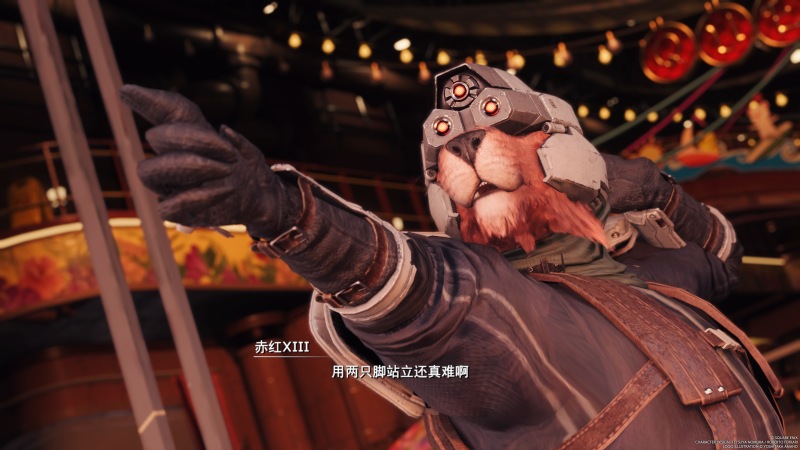
In quality mode, the game often feels like a movie. More importantly, it uses that visual power in smart ways. Cutscenes are not just between story beats. You get cinematic moments during travel, during fights, and even in side quests. After a CG segment, it often flows right into real-time scenes with no break. Square Enix leaned hard into staging here, and it shows.
A “Wide-Linear” World Done Right
I assumed Rebirth would be a full open world. Instead, it is a set of large zones: six major regions, one sea region, plus two story-only areas.
The connections are not seamless. You usually transition via story or a dungeon, and you fast-travel when you return later. Each region is its own open playground. The maps are huge, and the game fills them with meaningful points of interest and smart guidance.
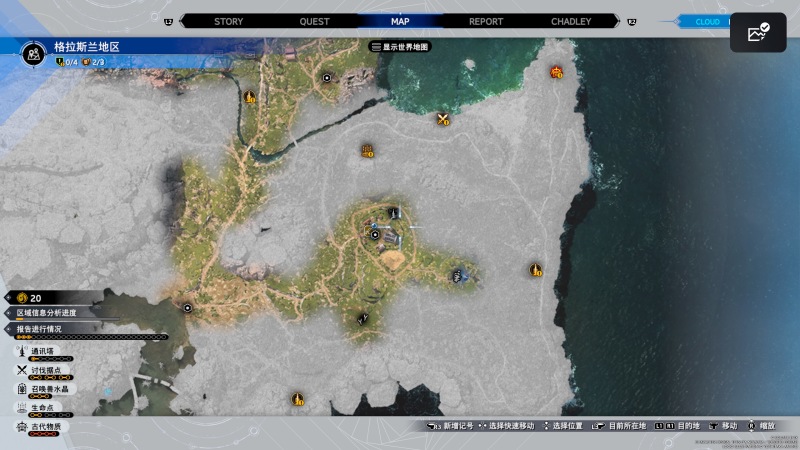
As soon as you enter a new area, you need a chocobo. Following its tracks naturally leads you to a communications tower. Climb it and the nearby points of interest appear on your map.
Maybe it reveals a hunt spot. On the way, you might spot a chirping colorful bird. If you follow it, it guides you to a life spring. Syncing with a life spring unlocks regional lore and reveals treasure dig sites or ancient materia locations.
Keep exploring and you might spot a glowing square stone. Break it and follow the light orbs to a summon crystal, then sync to make that summon easier to defeat in the simulator.
Sometimes a baby chocobo hops over to greet you. Follow it and you find a broken chocobo stop. Fix it to unlock a rest spot that heals HP and MP.
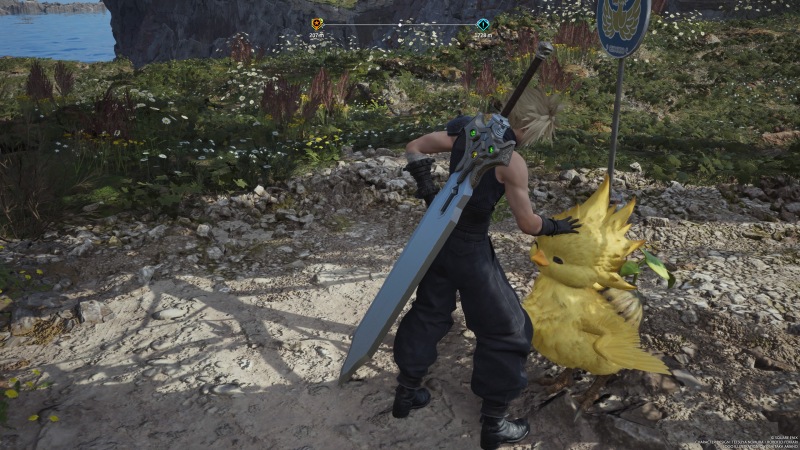
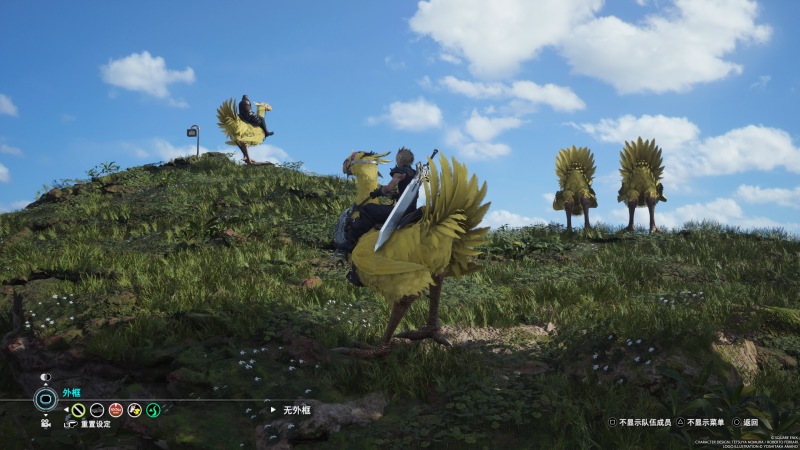
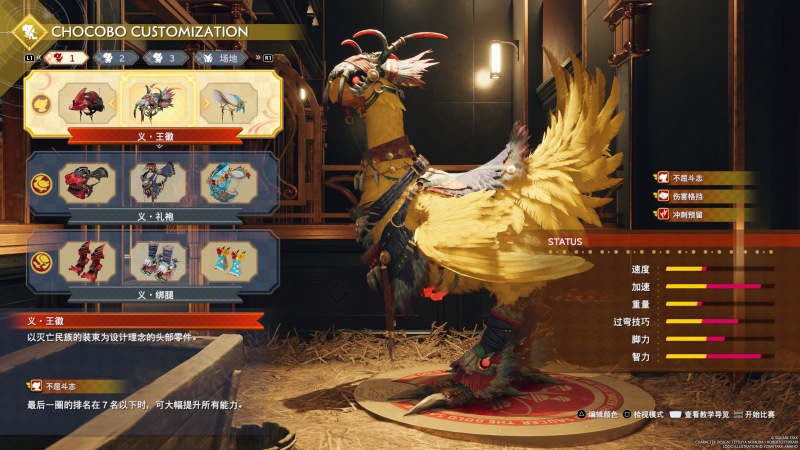
These activities are not copy-pasted checklists. Capturing chocobos, for example, starts simple with stealth in tall grass, then later adds moving cover, distraction rocks, and bait to guide routes. Each region’s chocobo has a unique ability: mountain chocobos climb, forest chocobos jump mushrooms and slide branches, sky chocobos glide, sea chocobos can boost across water. Towers and life springs are designed around those abilities.
Hunt spots serve as combat tutorials. To fully clear them, you often need to trigger Heat, trigger Break, and finish within a time limit. It pushes you to understand each character’s strengths and enemy weaknesses. Finish all hunt spots and you unlock a hidden hunt boss that tests what you have learned.
Summon crystal syncing is a rhythm memory game. It is not hard, and completing it reduces the summon difficulty in the simulator while improving the summon materia reward.
Ancient materia sites are basically side challenge rooms with unique mechanics or mini-games, different in each region. There is also a Moogle house in each area. Beat their prank challenges to unlock a Moogle shop with useful items.

The variety, paired with gentle guidance, keeps exploration engaging. This is Square Enix’s best open exploration yet, and it rarely feels repetitive.
Do not skip the side quests. The presentation is strong, but more importantly the stories matter. You see the party outside the main plot, and their ties to each region often hit hard.
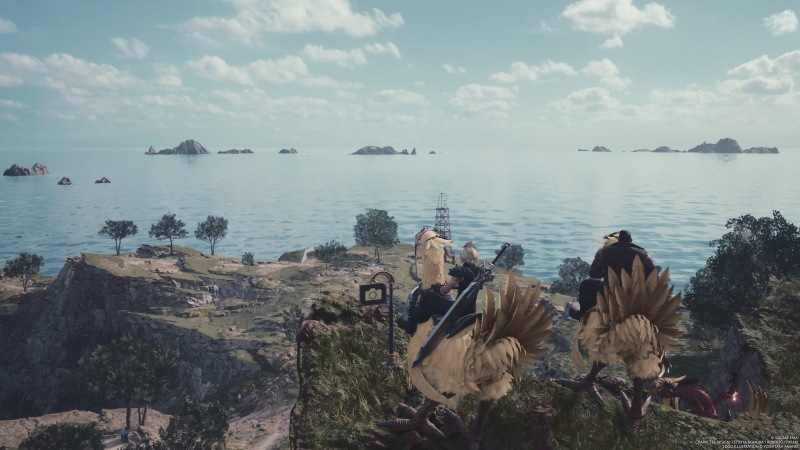
Even so, the world design is not flawless. Thanks to the improved visuals, most distant scenery looks reachable, which is great. But when you reach the official photo spots, you often sit at the boundary and stare into a flat ocean horizon. It feels strangely empty for a fantasy world.
Traversal still follows Remake’s logic. Large height differences are hard walls. Even with chocobos, you are often stuck on predefined routes. Not every wall can be climbed, not every cliff can be flown over.
Only in the final region, once you unlock the sea chocobo’s jet boost, do you get real freedom to roam. And since each chocobo is locked to its region, you cannot take that freedom elsewhere. It dulls the sense of a fully open world.
A Feast of Mini-Games
If there is a single area where Rebirth surprised me the most, it is mini-games. Fort Condor, squats, the G-bike, box smashing all return, with new twists. New additions like chocobo racing, pirate mayhem, and 3D Brawler have bespoke arenas and tiered challenges.
Instead of a handful of short diversions like in Remake or Intergrade, Rebirth has close to twenty mini-games across wildly different genres. Listing them all would be long, so I will focus on the two that stuck with me most: Queen’s Blood and the piano.
Queen’s Blood is a card game. Two players place cards on a 3x5 board to claim squares. Once the board is full, the total power of each row decides the winner.
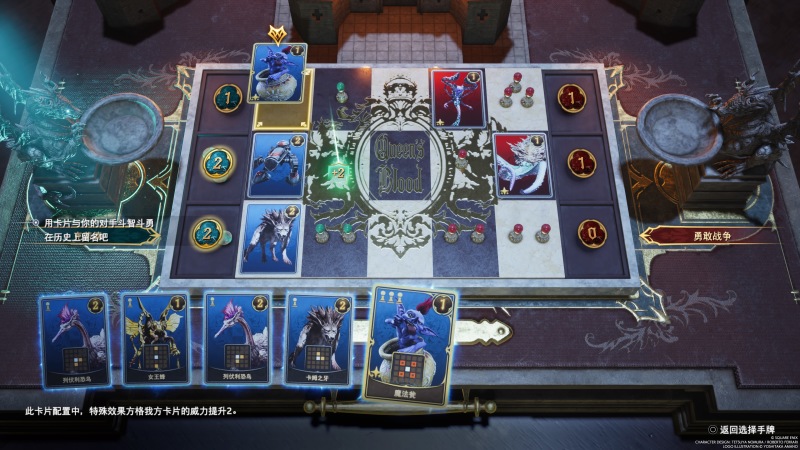
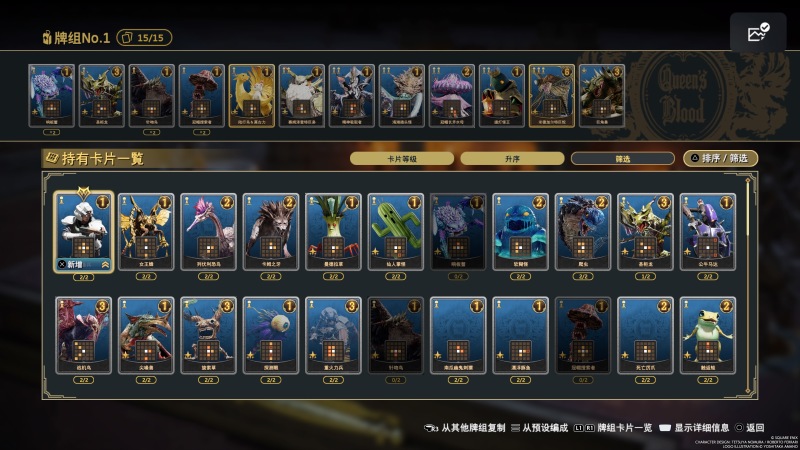
There are nearly a hundred collectible cards, ranked from 1 to 3 stars. Higher-ranked cards are stronger but can only be placed on higher-ranked squares. Rank 1 cards grab territory and raise square ranks. Rank 2 cards trigger special effects, like boosting a square or destroying an enemy card. That opens the door for Rank 3 cards to stack huge power.
One example: the Rank 3 Midgardsormr gains +1 power whenever any card is destroyed. So you build around Rank 2 destroy effects to repeatedly trigger it. Meanwhile, some Rank 1 cards have on-death effects, which makes destruction chains even better.
That is just one deck idea. You constantly adapt to opponents, build around counters, and experiment with new combos. The strategy depth is strong enough that it could stand on its own.
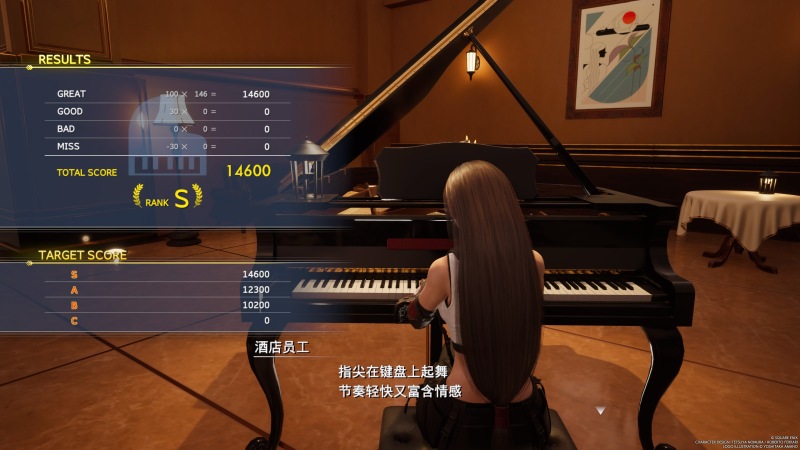
The piano mini-game is less innovative, basically a rhythm game with rearranged classic FF7 tracks. The twist is the control scheme: you use both analog sticks, with eight directions each, to simulate sixteen piano keys.
As your combo grows, additional instruments fade in. The cleaner you play, the richer the ensemble sounds. Some piano tracks are tied to side quests, so you can play while the scene unfolds around you. When the crowd and the on-stage musicians react to your performance, even a familiar melody hits harder.
Nailing a perfect performance and seeing the NPC reactions feels fantastic. And it is not just the piano. Almost every mini-game has its own little stagecraft, and by the end you feel like a local celebrity, the “mini-game king.” It is a funny and strangely satisfying vibe.
Mini-games unlock steadily as you progress, and they keep the momentum strong all the way to the end. A JRPG that sustains this kind of variety is rare.
The downside is obvious: not everyone is good at every genre. If you are a completionist, late-game mini-game challenges can feel like a slog, especially since higher difficulties often punish a single mistake with a full restart. That is more about player tolerance than a design flaw, but it is real.
Seven Fighters, One Avalanche
Rebirth’s combat system is close to Remake’s at its core, but the expanded synergy mechanics change the feel significantly. Intergrade introduced synergy, but Rebirth pushes it further across the full seven-person party.
You unlock synergy abilities and synergy skills on each character’s folio. Synergy abilities require ATB from both linked characters, but when they trigger they do not cost ATB, just like limit breaks, and the animations are invincible.
These dual attacks deal solid damage and grant strong temporary buffs, like a level 3 limit gauge or zero MP consumption for a short window. They are perfect for chaining into big skills or finishing a Break. Some bosses even have attacks that can only be interrupted by synergy abilities.
Synergy skills, on the other hand, cost nothing. They are advanced normal attacks that help connect combos, like Tifa’s dodge counter or Barret’s triple rush. Used well, they create smooth, action-game-like strings between basic attacks and ATB skills.
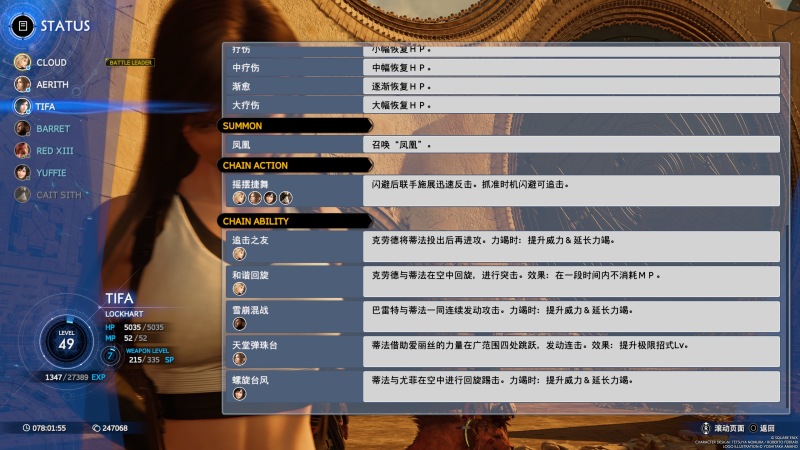
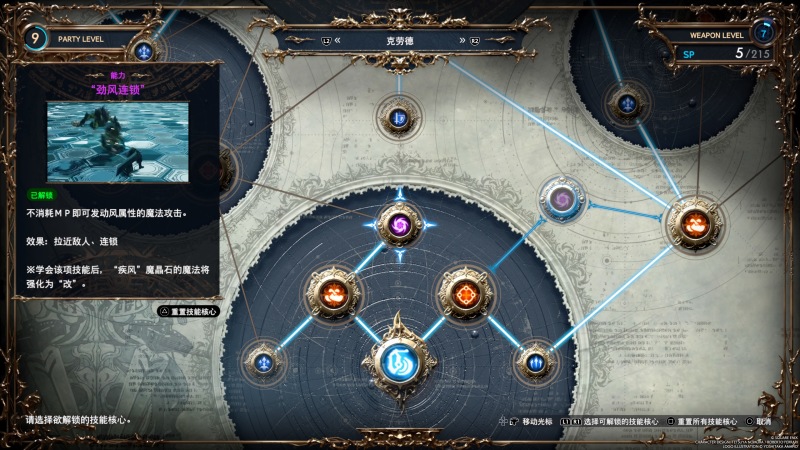
If you do not want to lean into synergy, you can still play like Remake. The folio can be reset for free, so you can tailor builds to your style.
The folio also unlocks elemental spells that cost no MP. That reduces early materia pressure and frees slots for auto-cast materia, which lets the AI help build synergy gauges.
Weapons also bring new twists. Cloud’s Prime Mode turns him into a brute force monster. Aerith’s sorceress mode shifts her normal attack into a charged beam and adds a time-stop field that freezes nearby enemies. Tifa’s Secret Technique: Rupture changes her move set from physical to non-elemental magic, making Heat buildup easier. Barret’s extra ammo boosts his basic firepower, while Soul Burst grants an ATB boost to the entire party.
Each of these changes is useful on its own. Combine them with Yuffie’s constant element swapping, Red XIII’s defensive counters, and Cait Sith’s Moogle summon tricks, and party builds become wildly flexible.
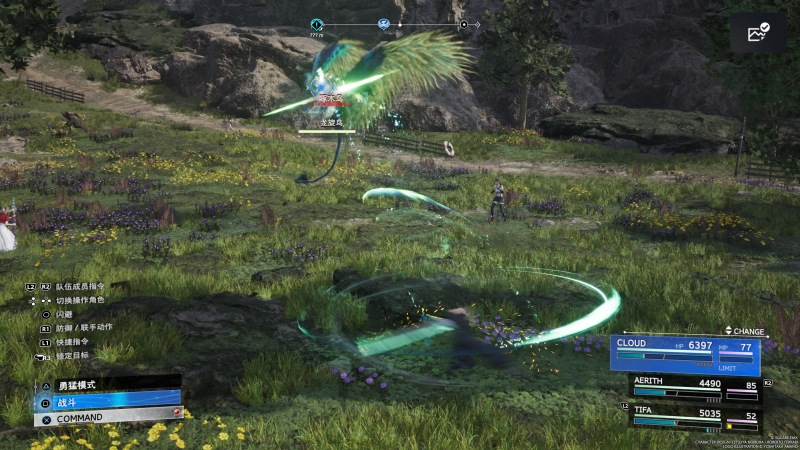
No matter how you build, the reserve members still appear in combat. You only control three, but you see all seven on the field. The reserves slowly build synergy gauges, and at key moments they can still contribute buffs or finishing hits. When that happens, the “Avalanche spirit” finally feels real.
Conclusion
By the time I finished Rebirth, I had spent around 60 hours. The game kept throwing new set pieces and new mini-games at me. I would sync one life spring, and another treasure site would immediately pop up nearby.
Even as the middle part of a remake trilogy, Rebirth constantly feels new. Compared to Remake, the amount of content is easily doubled. The larger, reimagined story delivers plenty of emotional moments as well.
One of the co-directors said in interviews that this is the most content-rich entry in the series. I agree.
Score: 9.5/10
Pros:
- Presentation and cutscenes are top tier
- Strong guidance within wide-open zones
- Dense, satisfying exploration
- A huge and varied mini-game lineup
- Synergy mechanics deepen combat
Cons:
- Traversal rules still feel too rigid
- Some mini-games will be frustrating for certain players